Acting SMART
12 Sep 2024SMART questions are essential for software engineers who want to solve problems. By acting SMART, anyone in any field can communicate more efficiently and contribute to the collective knowledge of their field.
The Importance of Acting SMART
As the title says, it is not solely about asking SMART questions but being SMART, which involves making the best effort to solve an issue before asking a question–among other things. Engineers can demonstrate a commitment to problem-solving and respect for others’ time and expertise by using SMART questions.
In this essay, we will explore why SMART questions are crucial, examine the criteria for SMART questions, and reflect on the insights gained from this evaluation.
Why
First and foremost, SMART questions bring efficiency to problem-solving. They streamline troubleshooting by defining the problem, outlining steps already taken, and specifying the context. Clarity when asking questions also reduces redundant efforts and accelerates finding solutions, making the process more productive and effective.
Besides efficiency, learning from a situation is the best boon. By articulating problems clearly and documenting what has been attempted, engineers and others contribute to a learning process that benefits themselves and the community. The documentation helps in understanding common issues and their resolutions or lack thereof. Well-asked questions contribute to the knowledge base available to the broader community. They become reference points for others facing similar problems, thus creating a collaborative effort and gain.
When asking a question, people who help should be taken into consideration. Providing a well-structured question shows respect for their time and effort. It also ensures that responders do not have to dig through or wait for vague or incomplete information, this leads to more focused and practical assistance.
Analysis of Questions on StackOverflow
The SMART question I found was about getting an element’s CSS property value as it was set in various units. The question provides a specific example with code and describes what has been attempted, using getComputedStyle and CSS () and their behaviour. The mention of the Chrome Inspector is particularly useful for understanding the context of the question.
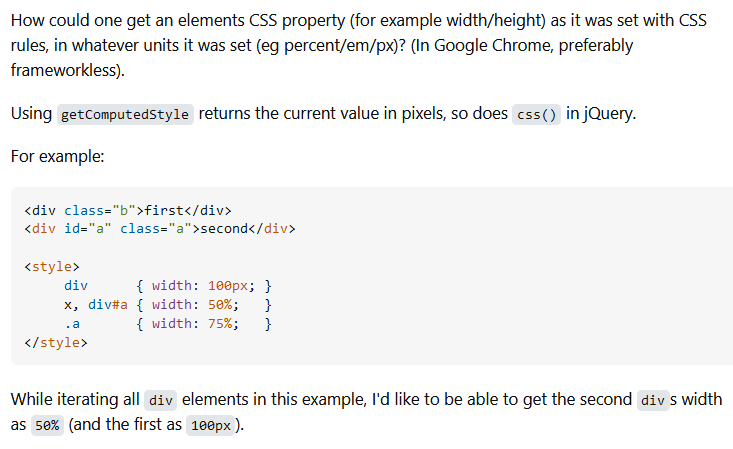
As mentioned, the question includes snippets of HTML and CSS code, which helps to clarify the issue. It shows a level of detail about the problem and expectations. The user demonstrates learning by referring to existing methods and noting what did not work. The question is specific about the desired outcome (getting the original unit’s value) and the current methods’ issue. The question is well done, but they could improve by mentioning any resources they have looked at, like documentation.
The non-SMART question I found is about Spark 2.3.0, and the error with LibSVMFileFormat. This post fails to hit a few of the key points of a SMART question. In the end, the question was never answered.

The question needs more details about what was done to resolve the issue before posting. It only provides the error message and some code snippets without indicating any troubleshooting steps. There is no indication of prior debugging. The user does not mention perusing documentation or trying any solutions. The error message is clear, but the question needs to explain the conditions in place further. Doing so would make it easier to provide a targeted solution. Later, another user had the same issue and posted a reply to the question. The author had found a solution and shared it when asked. A significant positive to having a community is having a collaborative network. Finding a solution to an issue you had that was not resolved is critical for us to grow as a community. Posting the solution that worked for him would have helped others who had viewed the post.
Insights Gained
Evaluating these posts, it becomes clear that the quality of a question could affect the efficiency and quality of problem resolution. Having a well-structured question not only aids in quicker solutions but also contributes positively to the community by serving as a reference for similar issues. These questions highlight the importance of providing comprehensive details, documenting efforts, and being specific about issues.
Furthermore, this exercise features the value of continuous learning and exploration in problem-solving. By showing what has been tried and understanding the context, others can make seeking help more productive and mutually beneficial.
Acting SMART is crucial to effective problem-solving and knowledge sharing in software engineering. It helps address issues efficiently, facilitates learning, and respects the community’s contributions.
If you want to learn more, here is a guideline on How To Ask Questions The Smart Way.